
China Tightens Export Filing for PET Dividers




On June 11, 2026, a new sustainability signal from China’s express delivery sector moved beyond packaging rhetoric and into export compliance. The release of a bamboo-substitution initiative, together with a related joint assessment by the Ministry of Ecology and Environment and the General Administration of Customs, means exporters of office partitions containing PET, including PET Acoustic Desk Dividers, face a changed filing path from Q3 2026. For manufacturers, exporters, buyers, testing providers, and overseas importers, the issue is not only material choice but also whether supporting documents can keep shipments moving without customs disruption.
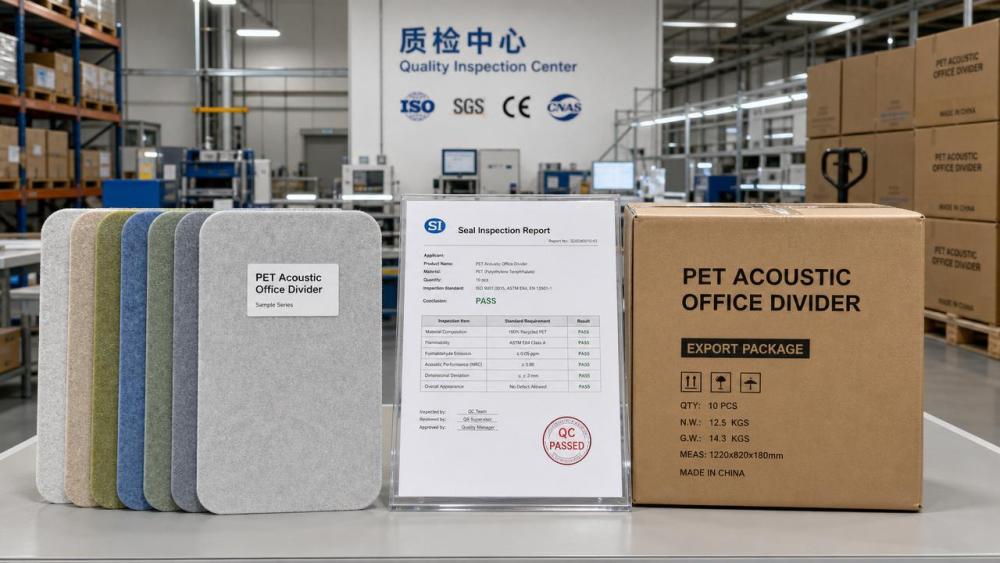
What the June 11 policy signal formally introduced
According to the provided event summary, the China Express Association issued a special initiative in Sanming, Fujian on June 11, 2026 focused on replacing plastic with bamboo and promoting greener packaging practices. The initiative set a target of 50% average annual growth in bamboo packaging from 2026 to 2030 and, for the first time, included bamboo-based materials in a mandatory green packaging substitution catalogue.
The same summary states that this policy move has already triggered a joint assessment by the Ministry of Ecology and Environment and the General Administration of Customs. As a result, all export-oriented office dividers containing PET are required from Q3 2026 to submit an additional feasibility statement on bio-based material substitution and a VOCs migration test report. The summary further notes that failure to provide these materials may affect customs clearance and release, and that overseas importers need to coordinate in advance with Chinese suppliers on compliance upgrades.
Where the pressure is likely to appear first in the trade chain
Export filings shift from product description to substantiation
From an industry perspective, exporters of PET-containing office dividers are the first group likely to feel the change because the new requirement is tied directly to customs documentation. The practical impact is not limited to classifying the product correctly; it also extends to whether the exporter can provide a documented explanation of why a bio-based alternative is or is not feasible, together with a VOCs migration report that supports the filing package.
Manufacturing and sourcing teams may need earlier material reviews
Manufacturers and procurement teams may be affected because the filing change links product composition to export readiness more directly than before. Analysis shows that companies using PET in acoustic or office-divider products may need to review whether current bills of materials, supplier declarations, and technical specifications are sufficient to support the additional submission requirements. Even where the product itself does not change immediately, the compliance burden around that product may still increase.
Overseas buyers face a supplier-coordination issue, not only a shipping issue
For overseas importers and procurement-side buyers, the provided summary points to a coordination risk. If the Chinese supplier has not prepared the required feasibility statement and VOCs migration report before shipment, the disruption may surface at the customs release stage rather than at order placement. What deserves closer attention is that importer readiness in this case depends on the supplier’s document completeness, testing preparation, and timing of compliance updates.
Testing and document support functions gain operational importance
Testing service providers and compliance support teams may also see higher operational relevance because the rule change specifically mentions VOCs migration testing and supplementary explanatory materials. Observably, this does not automatically mean a broader certification overhaul, but it does mean that technical documentation and test reporting become more central to export execution for the affected product category.
What companies should review before Q3 2026
Check which SKUs fall within the PET-containing scope
Analysis shows that a first practical step is to identify which export-facing office partition products contain PET and therefore may fall within the stated requirement. This matters most for companies shipping acoustic desk divider products or adjacent partition categories where material composition may not have been treated as a customs-risk issue before.
Prepare supporting files that can survive document scrutiny
Companies should pay close attention to whether their technical files can support the two named additions in the summary: a feasibility statement on bio-based substitution and a VOCs migration test report. It is more appropriate to understand this as a documentation-readiness issue at this stage, because the provided information does not yet set out broader implementation details beyond those filing elements.
Align supplier, exporter, and importer timelines
Observably, the timing risk is shared across the transaction chain. Chinese suppliers, exporters, and overseas importers may need earlier coordination on test scheduling, document preparation, and shipment planning so that compliance work does not begin only after goods are ready to move. For purchase contracts and delivery scheduling, this may affect lead-time assumptions even if no formal rule text beyond the summary has yet been provided.
Watch for changes in wording used by customs and buyers
What deserves closer attention is whether subsequent official wording, procurement specifications, or buyer compliance checklists begin to reference bamboo-based substitution, bio-based feasibility, or VOCs migration documentation more explicitly. The current information supports caution, but not assumptions about a fully standardized market practice yet.
Why this looks like an execution signal rather than a broad market conclusion
Analysis shows that this development is best read as a concrete compliance signal tied to export procedures, not simply as a general sustainability statement. The notable shift is that a packaging-related policy direction has already been connected to customs and environmental review for a defined group of PET-containing export products. At the same time, it remains too early to treat the event as proof of a wider, fully detailed regulatory framework across all related materials or products, because the provided information does not include further implementation rules, testing standards, or customs operating notices.
From an industry perspective, the key observation is that the rule change has moved one step closer to execution: documentation and test evidence are now part of the practical discussion. That makes this more than a symbolic industry initiative, while still leaving room for continued observation of how authorities and market participants will apply the requirement in detail.
How this update is best understood now
At this stage, the event is best understood as a landed compliance change with immediate relevance for export preparation, especially for PET-containing office dividers. It does not yet justify broad assumptions about final enforcement patterns beyond the details provided, but it does justify earlier internal review of materials, testing, filing files, and supplier-buyer coordination. In neutral terms, this is less a general market forecast than a practical warning that documentation standards for affected exports are becoming more demanding.
Basis of this article and what still needs verification
This article is generated from the user-provided news title, event date, and event summary. For events of this type, relevant source categories usually include official notices, releases from regulatory authorities, customs or trade administration information, industry association announcements, standard-setting documents, and reporting by authoritative media. No specific official source link was provided in the input, so the exact official link remains to be verified on an ongoing basis.
Further observation is still needed on the detailed policy wording, the eventual compliance interpretation used in practice, any changes in tender or procurement documents, industry feedback, and how companies implement the required upgrades before the Q3 2026 timeline referenced in the provided summary.
Related News
- China Tightens Export Inspection for Office Acoustics: PET Dividers and Booths Need NRC ReportsAug 14, 2026China tightens export inspection for office acoustics. PET dividers and booths now need NRC reports, so exporters can avoid delays and clear customs faster.
- EU PPWR Takes Effect Aug. 12, EPR Filing Now RequiredAug 11, 2026EU PPWR takes effect Aug. 12, making packaging EPR filing essential for EU-bound office furniture. Learn how to protect listings, customs clearance, and delivery compliance.
- REACH SVHC Update Triggers PET Divider RetestingAug 10, 2026REACH SVHC update triggers PET divider retesting as three phthalates hit the Candidate List. Learn the 90-day compliance risks, testing actions, and EU market impact.
- CPSC Rule Sets Dual PET Divider ThresholdsAug 08, 2026CPSC Rule Sets Dual PET Divider Thresholds: learn how new U.S. rules for PET acoustic desk dividers impact NRC ratings, formaldehyde limits, compliance documents, and market access.
Related News
- 00
0000-00
How to Evaluate a Commercial Lounge Furniture Manufacturer for High-Traffic Projects - 00
0000-00
Office Furniture Compliance Requirements: A Facility Manager’s Checklist - 00
0000-00
How Smart Office Furniture with Booking Improves Shared Workspace Utilization - 00
0000-00
Chair Comfort Testing: Metrics That Predict All-Day Support in Office Seating - 00
0000-00
Workplace Sedentary Health Solutions: Designing Movement Into Daily Work
Weekly Insights
Stay ahead with our curated technology reports delivered every Monday.