
China Customs Tightens Dual-Use Review on PET Dividers




On February 1, 2026, a new China Customs compliance requirement took effect under General Administration of Customs Announcement No. 9 of 2026. The change centers on stricter dual-use review for exported equipment with combined acoustic and structural functions, and its scope now affects PET acoustic desk dividers used in office systems. For exporters, manufacturers, compliance teams, and supply chain service providers, the issue is not only the rule itself but also the immediate effect on declaration documents, product classification, technical files, and supporting test materials.
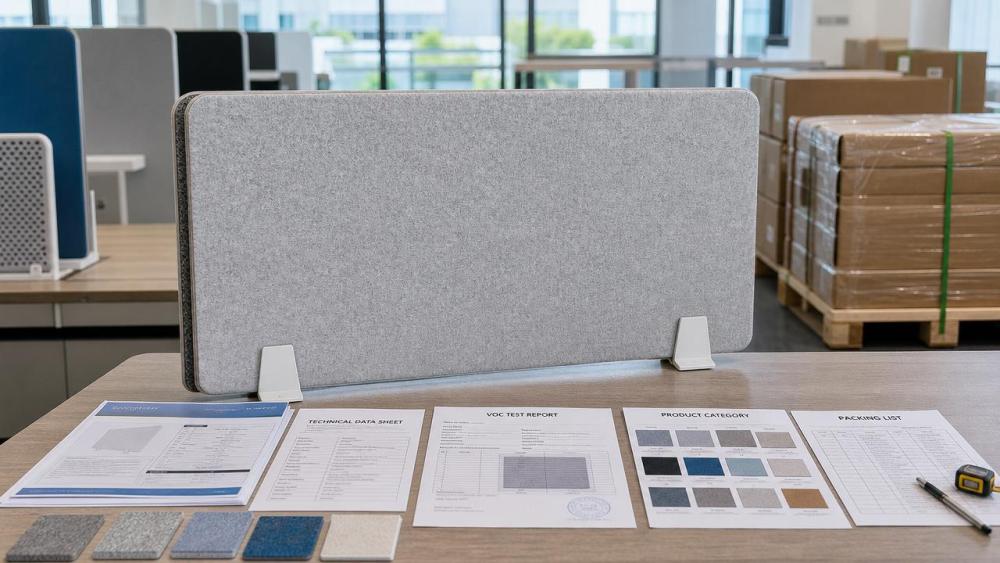
What the new customs requirement now covers
The confirmed facts are limited but clear. General Administration of Customs Announcement No. 9 of 2026 came into force on February 1, 2026. It requires exporters of equipment with acoustic and structural composite functions to submit complete technical parameters, a statement of intended use, and a dual-use compliance commitment. Although the rule was introduced in connection with dredging equipment, the current requirement has extended to office partition systems that include polymer composite materials, acoustic damping structures, and embedded electronic modules, including PET acoustic desk dividers. Exporting companies are also required to update HS code classification and VOC test reports in parallel.
Where the pressure now appears in the export chain
For exporters, the declaration file becomes more technical
Exporters may be affected first because the new review requirement directly changes the content of export submissions. The impact is likely to appear in product declaration, internal compliance review, document preparation, and communication with customs or trade service partners. What deserves closer attention is whether the company’s existing product sheets, intended-use statements, and dual-use compliance materials are detailed enough to support the declaration process.
For manufacturers, product design details now matter in trade compliance
Manufacturing companies involved in PET office divider systems may face closer scrutiny where products combine polymer composite materials, acoustic damping structures, or embedded electronics. From an industry perspective, this shifts some compliance pressure upstream into product documentation, bill-of-material alignment, and technical description consistency. Even when the physical product does not change, the trade-facing description of that product may now require more precision.
For testing and certification support, document consistency becomes critical
Testing service providers and certification-related businesses may see greater demand for updated VOC reports and supporting technical documentation. The immediate issue is less about a new certification regime and more about whether existing reports, compliance statements, and product specifications remain usable under the revised declaration expectations. Observably, any mismatch between test documents, product claims, and customs classification could become a practical bottleneck.
For procurement and delivery teams, timing risk may rise
Procurement teams, project coordinators, and supply chain service providers may also feel the effect if shipments are delayed by additional document review or reclassification work. The key concern is not a confirmed delay period, which has not been provided, but the increased possibility that delivery planning, booking schedules, and handover timing may need more buffer where affected product categories are involved.
Practical issues companies should review now
Recheck how products are described for export
Companies should closely review whether export-facing product descriptions accurately reflect acoustic, structural, material, and electronic features. Analysis shows this is especially relevant for PET acoustic desk dividers and related office partition systems that may now fall within closer scrutiny.
Align HS classification with technical files
The summary provided makes clear that HS code classification updates are required. Businesses should therefore check whether internal classification logic, declaration wording, and technical parameter sheets are aligned, rather than treating classification as a separate administrative step.
Prepare supporting compliance statements in advance
The requirement for intended-use statements and dual-use compliance commitments means exporters should pay closer attention to the completeness and consistency of supporting files before shipment. Because the input does not provide detailed enforcement procedures, it is more appropriate to treat this as an area requiring ongoing monitoring rather than assuming a settled review standard.
Verify whether VOC reports remain current for declared products
The need to update VOC test reports suggests companies should confirm that existing reports still match the product version, material description, and declaration pathway being used. This is a practical checkpoint for both exporters and suppliers involved in documentation handover.
Why this looks like an execution signal, not just a policy headline
Analysis shows this development is more than a narrow rule aimed only at dredging equipment. The more important signal is that customs review logic is being applied to a broader set of exported products that combine material, acoustic, structural, and in some cases electronic characteristics. At the same time, it would be premature to treat the full enforcement boundary as settled, because the provided information does not include detailed interpretation standards, review timelines, or product-by-product examples. From an industry perspective, this should be understood as an implemented compliance change accompanied by areas that still require observation.
How the market is likely to read the change for now
At this stage, the most balanced interpretation is that the rule marks a real adjustment in export compliance expectations for certain PET office partition products, especially where product structure and function move beyond simple furnishings. The immediate consequence is a higher documentation threshold rather than a confirmed market outcome. For industry participants, the practical priority is to follow how customs practice, classification treatment, technical document expectations, and supporting report requirements are applied in actual transactions after February 1, 2026.
Basis of this article and what still needs verification
This article is generated solely from the user-provided news title, event date, and event summary. The specific official source link was not provided in the input and still needs to be verified on an ongoing basis. For this type of event, relevant source categories typically include official announcements, releases from regulatory authorities, customs or trade administration information, industry association updates, standard-setting documents, and reporting from authoritative media. Observably, the points that still require continued attention include detailed implementation language, certification and testing expectations, changes in tender or specification documents, market feedback, and how exporting companies actually execute the new requirements.
Related News
- China Tightens Export Inspection for Office Acoustics: PET Dividers and Booths Need NRC ReportsAug 14, 2026China tightens export inspection for office acoustics. PET dividers and booths now need NRC reports, so exporters can avoid delays and clear customs faster.
- EU PPWR Takes Effect Aug. 12, EPR Filing Now RequiredAug 11, 2026EU PPWR takes effect Aug. 12, making packaging EPR filing essential for EU-bound office furniture. Learn how to protect listings, customs clearance, and delivery compliance.
- REACH SVHC Update Triggers PET Divider RetestingAug 10, 2026REACH SVHC update triggers PET divider retesting as three phthalates hit the Candidate List. Learn the 90-day compliance risks, testing actions, and EU market impact.
- CPSC Rule Sets Dual PET Divider ThresholdsAug 08, 2026CPSC Rule Sets Dual PET Divider Thresholds: learn how new U.S. rules for PET acoustic desk dividers impact NRC ratings, formaldehyde limits, compliance documents, and market access.
Related News
- 00
0000-00
How to Evaluate a Commercial Lounge Furniture Manufacturer for High-Traffic Projects - 00
0000-00
Office Furniture Compliance Requirements: A Facility Manager’s Checklist - 00
0000-00
How Smart Office Furniture with Booking Improves Shared Workspace Utilization - 00
0000-00
Chair Comfort Testing: Metrics That Predict All-Day Support in Office Seating - 00
0000-00
Workplace Sedentary Health Solutions: Designing Movement Into Daily Work
Weekly Insights
Stay ahead with our curated technology reports delivered every Monday.