
US CBP Rule Raises Import Bond Burden




On June 3, 2026, the United States put forward a new customs enforcement measure that starts a 180-day reform process and immediately puts closer attention on import compliance for selected product categories. For PET acoustic desk dividers and ventilated meeting pods, the practical change is a higher bond requirement for importers, with coverage extending to duties, penalties, and contract-related liabilities. This is worth watching not simply as a policy update, but as a signal that financing, customs preparation, supplier coordination, and delivery planning may all come under tighter review for businesses involved in these products.
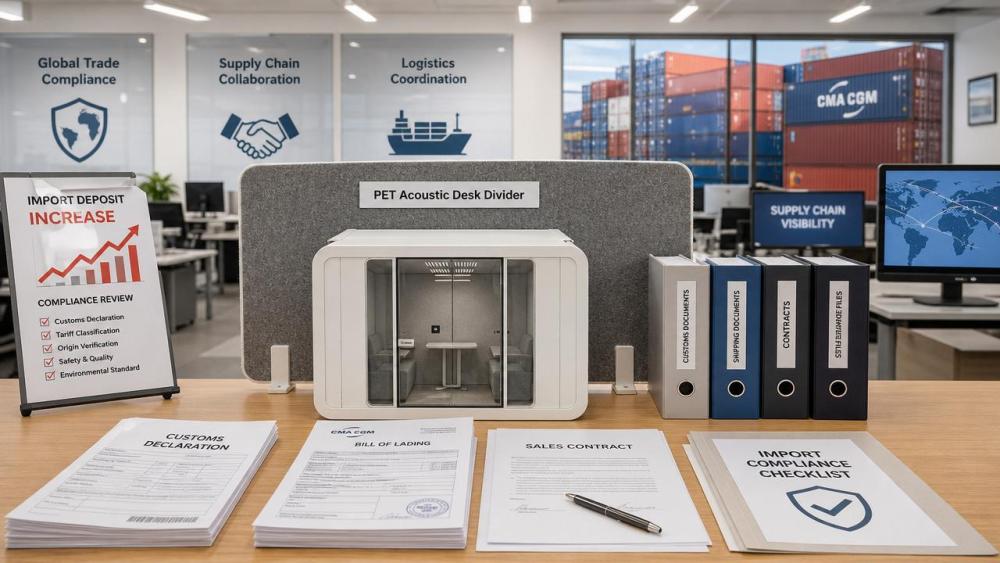
A narrower customs lens on higher-sensitivity products
The confirmed information is limited but clear. On June 3, 2026, the United States signed an executive order titled "Strengthening Customs Enforcement" and launched a 180-day customs regulatory reform process. Under this new rule, importers of PET Acoustic Desk Dividers and Ventilated Meeting Pods, among other products described as highly compliance-sensitive, are required to provide higher-value bonds. The bond coverage is stated to include duties, penalties, and contract default liabilities. The event summary also indicates that this will raise capital occupation costs and market entry thresholds for U.S. importers and affect global supply chain cooperation patterns.
Where the pressure is likely to appear first
Import-side trade operators may face a heavier pre-clearance burden
From an industry perspective, import-focused trading companies are likely to feel the rule change first because the bond requirement sits at the point where customs compliance and capital planning meet. The immediate area of attention is not only the shipment itself, but also the supporting document set, internal compliance review, and the commercial decision on whether a transaction remains viable under higher bond exposure.
Export manufacturers may encounter stricter customer-side screening
Analysis shows that manufacturers supplying acoustic partitions or meeting pods into the U.S. market may see customers ask for stronger compliance support before purchase confirmation. The operational impact may show up in product documentation, technical descriptions, shipment records, and delivery coordination, because importers facing higher bond costs are likely to review upstream risk more carefully.
Procurement and supply chain teams may need to revisit delivery assumptions
Observably, procurement teams and supply chain service providers may need to reassess order timing, supplier qualification, and buffer planning. When customs-sensitive products require more financial commitment at entry, even unchanged product demand can lead to different decisions on batch size, shipment rhythm, and counterpart selection. What deserves closer attention is whether bond-related pressure begins to influence lead-time commitments and contract negotiation practices.
What companies should monitor during the reform window
Keep compliance files ready for closer scrutiny
Analysis shows that companies involved in the affected categories should pay particular attention to whether product descriptions, technical files, test materials, and shipment documents are complete and internally consistent. The available information does not provide an execution checklist, so this should be understood as a practical area to monitor rather than a confirmed new document mandate.
Track later official wording and enforcement interpretation
Because the event summary refers to a 180-day customs reform process, what deserves closer attention is how later official language may define scope, treatment, and enforcement expectations for products considered highly compliance-sensitive. At this stage, it would be premature to describe the final implementation outcome as settled.
Review customer qualification and transaction structure
For exporters and suppliers, observably, a higher bond burden on the U.S. side may lead buyers to re-examine importer qualification, payment arrangements, and risk allocation in contracts. Companies should therefore pay attention to whether counterparties begin requesting additional compliance assurances, revised documentation, or adjusted delivery terms.
Watch for changes in tender and purchasing documents
It is more appropriate to understand this as a signal that procurement language may tighten before the full reform picture is clear. Businesses should monitor whether customer specifications, bidding documents, and internal purchasing standards start to reflect stronger customs, traceability, or liability-related requirements for these product groups.
Why this looks like both an active rule change and an early enforcement signal
In editorial observation, this development should not be read only as a narrow customs filing issue. The confirmed rule change already points to a concrete increase in bond obligations for specific imported products, so there is a real compliance and financing effect. At the same time, because the broader reform process runs for 180 days and no further execution detail is provided in the input, it is also reasonable to view this as an enforcement signal whose market impact will become clearer through later guidance, business responses, and practical customs treatment.
How the market may best read this development now
At this stage, the most balanced reading is that the measure has already changed the risk and cost framework for importing PET acoustic desk dividers, ventilated meeting pods, and similar compliance-sensitive items into the United States. The confirmed direction is tighter customs control through higher bond coverage; the unconfirmed part is how broadly and how uniformly the rule will shape day-to-day execution across contracts, sourcing, and delivery. For industry participants, this is less a one-day headline than a compliance signal that merits continued tracking.
Basis of this article and what still needs verification
This article is based on the user-provided news title, event date, and event summary. For developments of this kind, commonly relevant source types may include official notices, releases from customs or trade authorities, industry association updates, standards-related documents, and reporting by established business or trade media. No specific official source link was provided in the input, so the exact official publication path still needs to be verified on an ongoing basis. Further observation is also needed on later policy detail, enforcement interpretation, changes in tender documents, market feedback, and how companies implement compliance and delivery adjustments in practice.
Related News
- China Tightens Export Inspection for Office Acoustics: PET Dividers and Booths Need NRC ReportsAug 14, 2026China tightens export inspection for office acoustics. PET dividers and booths now need NRC reports, so exporters can avoid delays and clear customs faster.
- EU PPWR Takes Effect Aug. 12, EPR Filing Now RequiredAug 11, 2026EU PPWR takes effect Aug. 12, making packaging EPR filing essential for EU-bound office furniture. Learn how to protect listings, customs clearance, and delivery compliance.
- REACH SVHC Update Triggers PET Divider RetestingAug 10, 2026REACH SVHC update triggers PET divider retesting as three phthalates hit the Candidate List. Learn the 90-day compliance risks, testing actions, and EU market impact.
- CPSC Rule Sets Dual PET Divider ThresholdsAug 08, 2026CPSC Rule Sets Dual PET Divider Thresholds: learn how new U.S. rules for PET acoustic desk dividers impact NRC ratings, formaldehyde limits, compliance documents, and market access.
Related News
- 00
0000-00
Commercial Office Desk Procurement: A Checklist for Hybrid Workplace Projects - 00
0000-00
How to Evaluate a Commercial Lounge Furniture Manufacturer for High-Traffic Projects - 00
0000-00
Office Furniture Compliance Requirements: A Facility Manager’s Checklist - 00
0000-00
How Smart Office Furniture with Booking Improves Shared Workspace Utilization - 00
0000-00
Chair Comfort Testing: Metrics That Predict All-Day Support in Office Seating
Weekly Insights
Stay ahead with our curated technology reports delivered every Monday.