
EU Rule Takes Effect on PET Acoustic Dividers




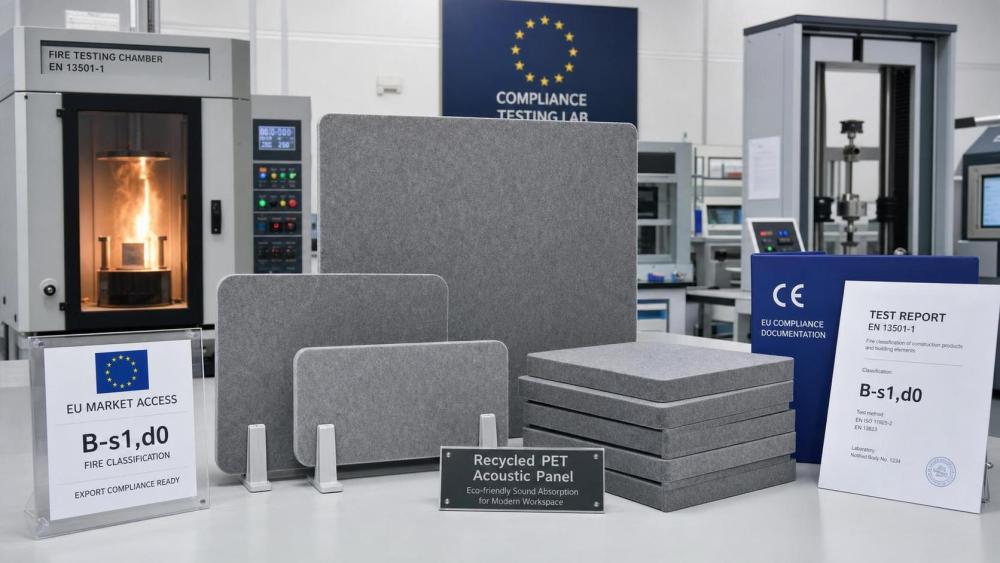
From July 1, 2026, the EU is enforcing revised implementation rules under the Construction Products Regulation (CPR), requiring imported office acoustic partitions made from recycled PET, including PET acoustic desk dividers, to obtain a B-s1,d0 fire classification under EN 13501-1:2024 before they can carry the CE mark and enter the market. For exporters, especially those shipping from China to the EU, the development deserves attention because it directly affects product compliance routes, testing timelines, and customs documentation preparation.
What the new market-entry requirement changes
The confirmed change is straightforward: as of July 1, 2026, recycled PET acoustic office partitions imported into the EU must meet the B-s1,d0 fire rating under EN 13501-1:2024. The scope explicitly includes PET acoustic desk dividers. Products that do not obtain this certification cannot be affixed with the CE mark and therefore cannot be placed on the EU market. Based on the information provided, the rule is tied to the EU's enforced implementation of revised CPR measures and has a direct bearing on compliance procedures, testing lead times, and clearance-related paperwork.
Where the pressure is likely to appear first
Export decisions move from pricing to compliance sequencing
From an industry perspective, direct trading companies are likely to feel the impact early because market access now depends not only on product shipment but also on whether certification has been completed in time. The main pressure point is the order of operations: testing, document readiness, CE marking eligibility, and shipment planning become more tightly linked.
Manufacturing schedules may be affected by testing lead times
Analysis shows that manufacturers of PET acoustic partitions may need to pay closer attention to production scheduling and model management. Since the requirement is tied to a specific fire classification under EN 13501-1:2024, the practical impact may show up in sample preparation, product approval timing, and the coordination between production and compliance work.
Customs and documentation services face higher document sensitivity
Supply chain service providers, including teams handling export documentation and customs preparation, are also likely to be affected. What deserves closer attention is that the inability to apply the CE mark is not only a product issue but also a market-entry issue, which means paperwork accuracy and readiness may become more consequential in shipment execution.
EU buyers may place more emphasis on proof of readiness
For importers, procurement teams, and downstream buyers in the EU market, the change may shift attention toward whether suppliers can present valid fire-classification evidence and complete compliance documents before delivery milestones. The effect is likely to be most visible in supplier screening, purchase confirmation, and lead-time communication.
What companies should monitor now
Confirm which product lines fall within the stated scope
Companies should first focus on whether their recycled PET acoustic partition products, including desk divider lines, fall within the scope described in the current information. This is a basic but necessary step because any compliance planning depends on accurate product classification at the business level.
Build testing time into delivery commitments
Analysis shows that testing cycles should be treated as part of commercial planning rather than as a final administrative step. For exporters and manufacturers, this matters because the information provided already points to an effect on testing timelines, which can in turn influence delivery promises and shipment windows.
Review CE-marking and document preparation workflows
What deserves closer attention is the connection between certification status and CE marking eligibility. Companies involved in export execution should review how compliance documents, product files, and customs materials are assembled, especially for shipments intended for the EU after the effective date.
Align customer communication with the effective date
Observably, the July 1, 2026 implementation date is not just a regulatory marker but also a contract and communication milestone. Businesses may need to clarify with EU customers how ongoing orders, future tenders, and delivery schedules will be handled when certification readiness becomes a condition for market entry.
Why this looks like more than a short-term filing issue
Analysis shows that this development is better understood as a concrete compliance threshold rather than a general policy signal. The immediate result is already clear in the information provided: without the required B-s1,d0 certification under EN 13501-1:2024, affected products cannot obtain CE marking for EU market access. At the same time, it is still appropriate to keep watching how the requirement is interpreted in day-to-day trade practice, especially around product scope, testing arrangements, and document handling. In that sense, the rule is both an effective near-term change and an ongoing operational issue for the supply chain.
How to read the significance of this update
For the PET acoustic partition segment, this is best read as an enforceable market-access condition with direct consequences for exporters, manufacturers, service providers, and buyers connected to the EU trade flow. It does not, based on the information available, justify broader conclusions beyond the affected product and compliance path. A neutral reading is that the key issue is not market sentiment but execution readiness: certification, CE-marking eligibility, and supporting documentation now sit closer to the center of transaction planning.
Basis of this report and points that still need verification
This article is based on the user-provided news title, event date, and event summary. For reporting of this type, commonly relevant source categories may include official regulatory notices, company disclosures, industry association updates, authoritative media coverage, and standard-setting documents. No specific official source link was provided in the input, so the precise official reference should continue to be verified. Follow-up attention should remain on any further official wording, implementation clarifications, and practical guidance affecting compliance scope, testing timelines, and customs document preparation.
Related News
- China Tightens Export Inspection for Office Acoustics: PET Dividers and Booths Need NRC ReportsAug 14, 2026China tightens export inspection for office acoustics. PET dividers and booths now need NRC reports, so exporters can avoid delays and clear customs faster.
- EU PPWR Takes Effect Aug. 12, EPR Filing Now RequiredAug 11, 2026EU PPWR takes effect Aug. 12, making packaging EPR filing essential for EU-bound office furniture. Learn how to protect listings, customs clearance, and delivery compliance.
- REACH SVHC Update Triggers PET Divider RetestingAug 10, 2026REACH SVHC update triggers PET divider retesting as three phthalates hit the Candidate List. Learn the 90-day compliance risks, testing actions, and EU market impact.
- CPSC Rule Sets Dual PET Divider ThresholdsAug 08, 2026CPSC Rule Sets Dual PET Divider Thresholds: learn how new U.S. rules for PET acoustic desk dividers impact NRC ratings, formaldehyde limits, compliance documents, and market access.
Related News
- 00
0000-00
How to Evaluate a Commercial Lounge Furniture Manufacturer for High-Traffic Projects - 00
0000-00
Office Furniture Compliance Requirements: A Facility Manager’s Checklist - 00
0000-00
How Smart Office Furniture with Booking Improves Shared Workspace Utilization - 00
0000-00
Chair Comfort Testing: Metrics That Predict All-Day Support in Office Seating - 00
0000-00
Workplace Sedentary Health Solutions: Designing Movement Into Daily Work
Weekly Insights
Stay ahead with our curated technology reports delivered every Monday.