
BIFMA Tightens VOC Limit for PET Desk Dividers




On July 2, 2026, BIFMA released a revision notice for X5.1-2026 that lowers the TVOC emission limit for recycled polyester fiber substrates used in PET acoustic desk dividers and adds a third-party low-VOC certification requirement. For suppliers, exporters, buyers, and testing-related service providers involved in PET divider products, this is a practical compliance change because it directly affects material selection, documentation, qualification review, and cost control in North American business.
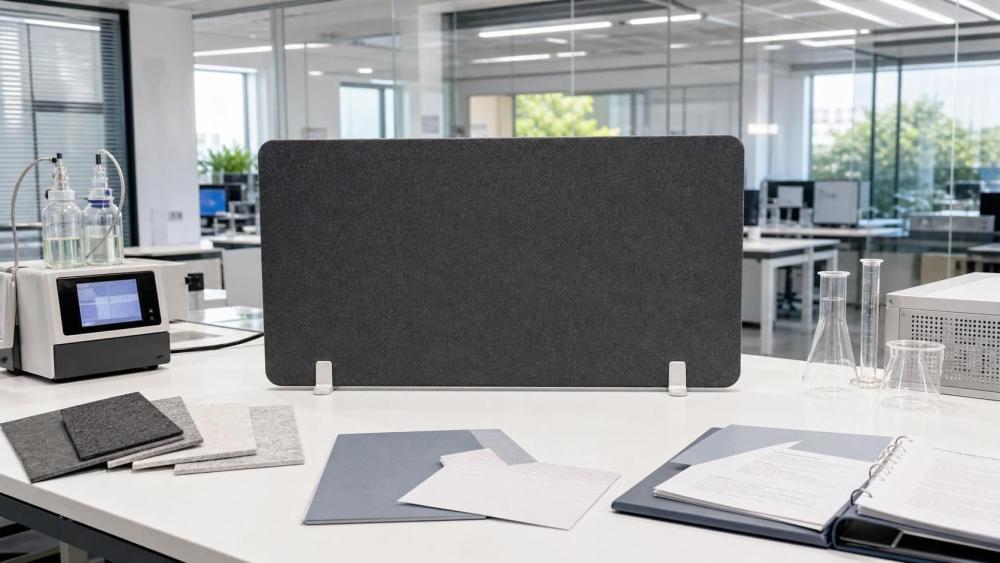
What the X5.1-2026 revision clearly changes
The confirmed information shows that BIFMA issued the X5.1-2026 revision notice on July 2, 2026. Under the revision, the TVOC emission limit for the recycled polyester fiber substrate used in PET Acoustic Desk Dividers has been reduced from 5.0 μg/m3 to 1.5 μg/m3. The notice also requires third-party low-VOC certification, with examples including GREENGUARD Gold or UL ECVP.
The provided information also indicates that this change will affect raw material selection and testing costs for Chinese PET divider suppliers. In addition, it is becoming a new point of focus in factory audits by buyers in the U.S. and Canada.
Where the compliance pressure is likely to appear first
Material sourcing will face a narrower acceptance range
From an industry perspective, suppliers and manufacturers using recycled polyester fiber substrates may be affected first because the revised threshold is directly tied to substrate emissions performance. The practical impact is likely to appear in upstream purchasing decisions, incoming material screening, and the need to confirm whether existing material options can still support compliance documentation for PET acoustic desk divider products.
Export-facing manufacturers may see more document checks
For export-oriented producers, the change matters not only at the product level but also in technical files submitted during customer review. What deserves closer attention is the growing importance of emission-related reports, third-party certification status, and product specification alignment when serving buyers in the U.S. and Canada. Where customer requirements are updated quickly, document readiness could affect order confirmation and shipment planning.
Buyer audits and qualification reviews may shift in emphasis
For procurement teams and channel-side buyers, the revision creates a clearer basis for checking whether supplied PET divider products meet a tighter VOC standard and whether certification evidence is available from a recognized third party. Observably, factory audits and supplier qualification reviews may place greater weight on testing records, certification validity, and consistency between raw material claims and delivered products.
Testing and certification support may become more operationally relevant
Testing service providers and certification-related firms may also be affected because compliance now depends not only on meeting a lower emission limit but also on presenting third-party low-VOC certification. In operational terms, this may increase attention on report availability, certification timing, and the completeness of technical support documents used in bids, audits, or customer approval processes.
What companies should check now
Review whether current materials still fit the revised threshold
Analysis shows that companies supplying PET acoustic desk dividers should first verify whether currently used recycled polyester fiber substrates can support the revised TVOC limit of 1.5 μg/m3. This is especially relevant where existing purchasing specifications were built around the previous 5.0 μg/m3 threshold.
Prepare certification files alongside test evidence
The added requirement for third-party low-VOC certification means companies should pay close attention to how certification documents, test reports, and product technical files are organized. Where customers request GREENGUARD Gold, UL ECVP, or equivalent proof, incomplete documentation could become a commercial issue even before product performance is discussed in detail.
Track audit language and bid document updates
Observably, one practical area to monitor is whether buyer audit checklists, tender specifications, or qualification forms begin to reflect the revised BIFMA wording more directly. The provided information does not define implementation details, so it is more appropriate to treat this as an area requiring close follow-up rather than as a fully uniform market practice already in place.
Watch delivery planning where retesting or requalification is needed
Where a supplier needs to switch materials, update testing, or complete third-party certification, delivery schedules and procurement planning may require adjustment. Analysis shows that this does not automatically mean disruption, but it does mean compliance timing should be reviewed alongside commercial commitments.
Why this looks like an execution signal, not just a technical edit
Analysis shows that the most important feature of this update is not only the lower numerical VOC threshold, but the combination of a stricter limit with a requirement for third-party certification. That combination gives purchasers and auditors a clearer compliance screen. It is more appropriate to understand this as an execution-oriented signal for the PET divider segment, especially for suppliers targeting the U.S. and Canadian markets, while still recognizing that the exact pace of market adoption and enforcement language needs continued observation.
How the market should read this revision for now
At this stage, the revision is best understood as a concrete compliance change with direct implications for materials, testing, certification, and buyer review priorities in PET acoustic desk divider business. The prudent reading is neither to overstate the outcome nor to treat it as a routine wording update. For affected companies, the immediate issue is readiness: whether product files, raw material choices, and qualification evidence can match a tighter VOC expectation in upcoming customer reviews.
Basis of this article and what still needs verification
This article is based on the user-provided news title, event date, and event summary. For developments of this type, commonly relevant source categories include official notices, regulator publications, trade authority information, industry association updates, standards organization documents, and reporting by authoritative media. A specific official source link was not provided in the input, so the exact source document should still be verified on an ongoing basis.
Further observation is still needed on execution details such as follow-up wording in certification practice, buyer audit criteria, tender document updates, industry feedback, and how companies implement the revised requirement in real transactions and deliveries.
Related News
- China Tightens Export Inspection for Office Acoustics: PET Dividers and Booths Need NRC ReportsAug 14, 2026China tightens export inspection for office acoustics. PET dividers and booths now need NRC reports, so exporters can avoid delays and clear customs faster.
- EU PPWR Takes Effect Aug. 12, EPR Filing Now RequiredAug 11, 2026EU PPWR takes effect Aug. 12, making packaging EPR filing essential for EU-bound office furniture. Learn how to protect listings, customs clearance, and delivery compliance.
- REACH SVHC Update Triggers PET Divider RetestingAug 10, 2026REACH SVHC update triggers PET divider retesting as three phthalates hit the Candidate List. Learn the 90-day compliance risks, testing actions, and EU market impact.
- CPSC Rule Sets Dual PET Divider ThresholdsAug 08, 2026CPSC Rule Sets Dual PET Divider Thresholds: learn how new U.S. rules for PET acoustic desk dividers impact NRC ratings, formaldehyde limits, compliance documents, and market access.
Related News
- 00
0000-00
How to Evaluate a Commercial Lounge Furniture Manufacturer for High-Traffic Projects - 00
0000-00
Office Furniture Compliance Requirements: A Facility Manager’s Checklist - 00
0000-00
How Smart Office Furniture with Booking Improves Shared Workspace Utilization - 00
0000-00
Chair Comfort Testing: Metrics That Predict All-Day Support in Office Seating - 00
0000-00
Workplace Sedentary Health Solutions: Designing Movement Into Daily Work
Weekly Insights
Stay ahead with our curated technology reports delivered every Monday.