
Sustainable Office Furniture Certifications: Which Labels Matter in B2B Procurement?




Sustainable Office Furniture Certifications: Which Labels Matter in B2B Procurement?
In B2B buying, sustainable office furniture certifications are more than marketing badges. They help verify safety, material transparency, indoor air quality, and environmental performance.
But buyers often face a crowded label landscape. Some marks support supplier approval and project compliance. Others add little value during commercial evaluation.
This guide explains which sustainable office furniture certifications matter most, how to compare them, and where they affect cost, risk, and long-term workplace value.
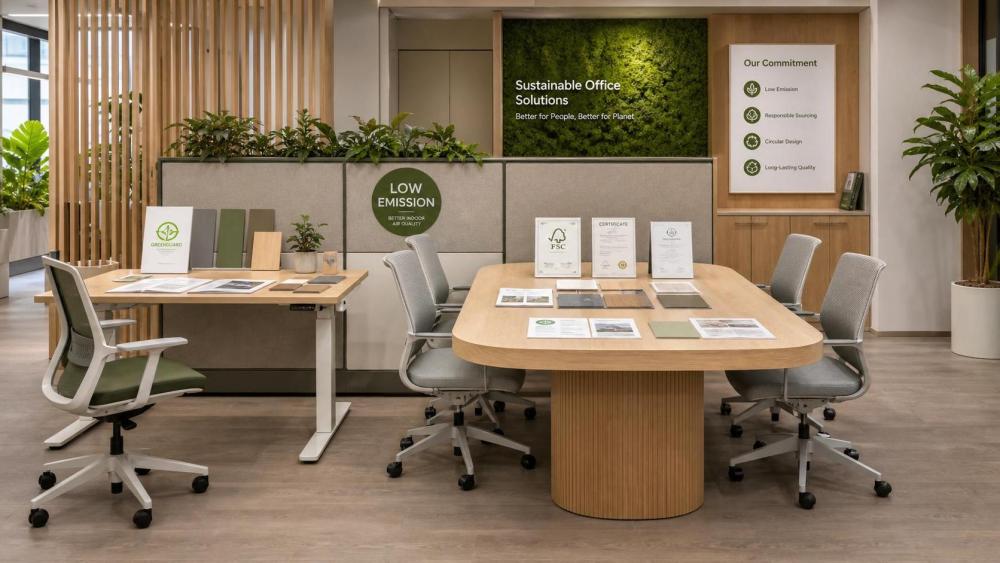
Why sustainable office furniture certifications matter in procurement
In real procurement work, sustainability claims are easy to make and hard to prove. Certifications give purchasing teams a faster way to screen suppliers.
They also reduce friction between procurement, facilities, design teams, and compliance reviewers. Everyone gets a shared reference point for decisions.
More importantly, sustainable office furniture certifications often connect directly to project risks. These include VOC exposure, restricted substances, recycled content accuracy, and end-of-life management.
For office chairs, sit-stand desks, acoustic pods, partitions, and lounge seating, the right label can influence specification acceptance, landlord requirements, and even employee experience outcomes.
The certifications that usually matter most
Not every label carries the same weight. In most B2B projects, buyers should focus on certifications that answer practical approval questions.
1. GREENGUARD and GREENGUARD Gold
These labels are widely used for indoor air quality. They test product emissions and are especially relevant for enclosed or high-density workspaces.
For acoustic pods, task chairs, desks, and partitions, GREENGUARD Gold can be a strong signal when low-emission materials matter.
This is often important in wellness-focused offices, education spaces, healthcare-adjacent areas, and projects targeting stricter interior standards.
2. FSC and PEFC
If wood, veneer, plywood, or fiberboard is involved, chain-of-custody matters. FSC and PEFC address responsible forest sourcing.
These are highly relevant for workstations, storage, conference furniture, and wall-integrated office systems with timber-based components.
Between the two, FSC often has stronger recognition in design-led and multinational procurement environments. Still, acceptance depends on buyer policy and market geography.
3. LEVEL by BIFMA
For North American commercial furniture, LEVEL is one of the most procurement-relevant sustainable office furniture certifications.
It covers multiple sustainability attributes, including materials, energy, human impacts, and social responsibility, using a furniture-specific framework.
That furniture focus makes it useful for comparing chairs, desks, storage, and tables without relying on scattered environmental claims.
4. SCS Indoor Advantage
SCS Indoor Advantage also addresses indoor air emissions. In many tenders, it plays a role similar to GREENGUARD.
The key point is not choosing labels for quantity. It is choosing one accepted emissions certification that aligns with project requirements.
5. Cradle to Cradle Certified
This certification is broader and more ambitious. It reviews material health, circularity, clean energy, water stewardship, and social fairness.
For buyers with strong ESG targets, Cradle to Cradle can be valuable. It is especially useful when circular procurement is part of the sourcing strategy.
Still, it is not always necessary for every project. Its value rises when clients want deeper sustainability evidence beyond baseline compliance.
Which labels influence approval fastest
From a practical procurement angle, the most influential sustainable office furniture certifications usually answer four questions quickly.
- Is the product low-emission for indoor use?
- Are wood materials responsibly sourced?
- Does the supplier use a recognized furniture sustainability standard?
- Can the claim be verified by a credible third party?
That is why GREENGUARD, FSC, and LEVEL often move faster in commercial review than lesser-known eco labels.
They fit common bid documents, LEED-related conversations, and internal approval workflows. Procurement teams do not need to educate every stakeholder from scratch.
How to evaluate sustainable office furniture certifications by product category
Different products carry different risk profiles. A smart sourcing process matches certifications to product-specific concerns.
Task chairs and seating
Focus on emissions, foam chemistry, textiles, and durability. Sustainable office furniture certifications should complement ergonomic and performance standards, not replace them.
Sit-stand desks and conference furniture
Look at wood sourcing, powder coating emissions, laminate chemistry, and packaging practices. For electric products, sustainability claims should sit beside safety and lifecycle reliability checks.
Acoustic pods and partitions
These products often combine fabrics, insulation, glass, adhesives, and ventilation components. Low-emission certification becomes especially relevant in enclosed structures.
Public seating and high-traffic furniture
Here, durability and maintenance cycles matter as much as recycled content. A short replacement cycle can undermine the sustainability story and increase total cost.
Common mistakes buyers make
A common mistake is treating all sustainable office furniture certifications as equal. They are not built for the same purpose.
Another issue is overvaluing self-declared claims. A brochure may mention recycled content or low VOC materials without credible third-party validation.
Buyers also sometimes collect too many labels without linking them to decision criteria. That slows sourcing and creates confusion during tender comparison.
And there is one more practical risk. A strong sustainability label does not guarantee comfort, acoustic quality, structural durability, or electrical reliability.
The best procurement decisions combine sustainable office furniture certifications with technical testing, warranty review, and supplier performance history.
A simple decision framework for supplier comparison
If the goal is faster and better sourcing, use a short filter instead of a long wish list.
- Start with category risk, such as emissions, wood sourcing, or circularity.
- Match each risk to one recognized certification.
- Confirm validity, scope, and certificate date.
- Check whether the certificate covers the exact product offered.
- Compare certification value against price, lead time, warranty, and maintenance.
This approach keeps sustainable office furniture certifications tied to procurement outcomes instead of turning them into a paperwork exercise.
What matters most for cost-conscious projects
For budget-sensitive projects, the right question is not whether certifications add cost. It is whether they reduce hidden cost later.
Low-emission products can support healthier interiors and reduce fit-out concerns. Certified wood sourcing can lower reputational risk. Recognized furniture standards can shorten approval time.
That said, buyers should avoid paying premium pricing for labels that do not affect occupancy requirements, ESG reporting, or bid compliance.
In many cases, two or three strong sustainable office furniture certifications are more valuable than a long list of minor claims.
Final take for smarter sourcing
The most useful sustainable office furniture certifications are the ones that help teams buy with less uncertainty. They should make supplier evaluation clearer, not more complicated.
For most B2B office projects, start with indoor air quality, responsible wood sourcing, and a recognized furniture sustainability framework. Then add deeper labels only when project goals require them.
When sustainable office furniture certifications are tied to product type, business risk, and total value, they become a practical sourcing tool rather than a branding exercise.
The strongest procurement outcome usually comes from balance: verified sustainability, proven performance, and suppliers that can document both with confidence.
Related News
- PBOC Draft Rule Opens Window on RMB Trade Payment TermsJun 22, 2026PBOC draft rule on RMB trade payment terms could reshape cross-border settlement, staged payments, and financing costs. Learn what exporters, buyers, and finance teams should review now.
- How to Choose an Office Renovation Planning Consultant for Phased Workplace UpgradesJun 22, 2026Office renovation planning consultant selection is critical for phased workplace upgrades. Learn how to compare experience, risk control, acoustics, furniture systems, and continuity planning.
- How to Evaluate a Commercial Furniture Sourcing Company for Multi-Site ProjectsJun 21, 2026Commercial furniture sourcing company evaluation for multi-site projects: learn how to compare delivery experience, compliance, logistics, and total value before you choose.
- Open Plan Acoustics Cost Explained: What Drives Price in Offices and Fit-Outs?Jun 21, 2026Open Plan Acoustics cost explained for offices and fit-outs: discover what really drives pricing, avoid hidden budget risks, and compare solutions that improve privacy, focus, and long-term value.
Related News
- 00
0000-00
Indonesia Extends Halal Rules to Public Seating Health Modules - 00
0000-00
Customs Spot Checks Add Test Filing for PET Desk Dividers - 00
0000-00
EU Ends €150 Small-Parcels Relief in July - 00
0000-00
BIFMA Compliance USA Explained: Which Office Furniture Tests and Labels Matter? - 00
0000-00
How to Specify Upholstered Auditorium Seating for Comfort, Durability, and Sightlines
Weekly Insights
Stay ahead with our curated technology reports delivered every Monday.