
FDA Draft Raises Low-VOC Thresholds in Office Procurement




On June 19, 2026, the U.S. Food and Drug Administration (FDA) issued a draft document titled Commercial Indoor Air Quality: Procurement Guidance for Ergonomic & Acoustic Furniture, bringing VOC limits into the technical specifications used in public purchasing for certain office furniture products. For manufacturers, exporters, procurement teams, testing providers, and bid-support functions tied to ergonomic and acoustic furniture, the development deserves attention because a non-mandatory guidance document is already being used as a practical entry requirement in some public tenders.
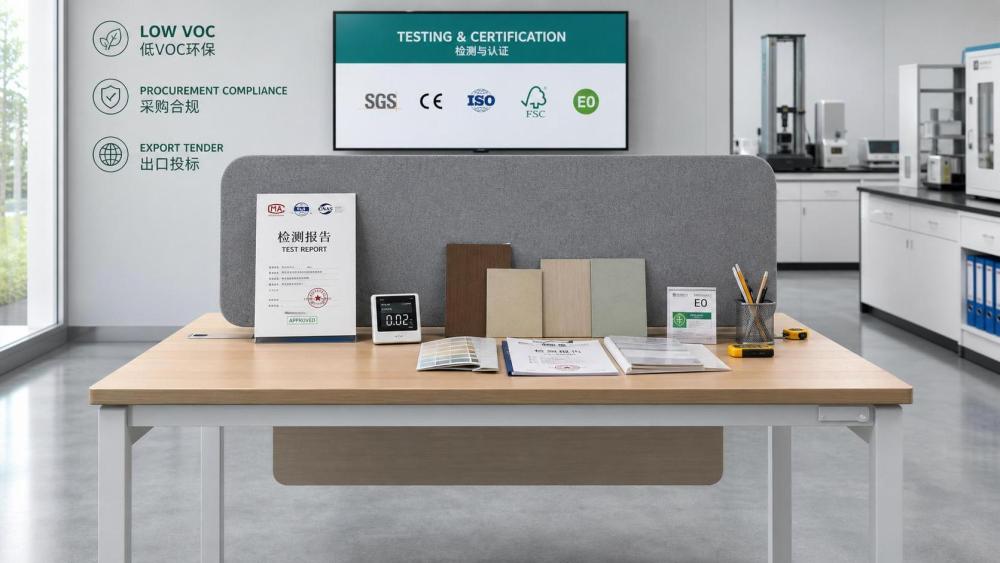
What the draft changes in procurement practice
According to the information provided, the FDA draft was released on June 19, 2026 and, for the first time, places limits on 12 categories of volatile organic compounds (VOC), including NMP, DMF, and benzene-series substances, into government procurement technical specifications.
The same draft requires products such as PET Acoustic Desk Dividers and Eco-friendly Executive Desks to provide third-party full-lifecycle VOC emission test reports issued by SGS or UL.
Although the guidance is described as non-mandatory, it has already been adopted by the GSA and the California Department of General Services as a prerequisite for tender participation.
Where the pressure is likely to appear first
Bid-facing product suppliers may see faster documentation demands
From an industry perspective, suppliers serving public-sector projects may be affected first because the change is tied directly to technical bid eligibility rather than only to marketing claims. The main impact is likely to fall on pre-bid document preparation, product specification alignment, and evidence submission for covered furniture lines.
What deserves closer attention is whether existing product files already include VOC-related evidence that matches the new procurement language, especially where tender access now depends on third-party reports rather than supplier declarations alone.
Manufacturing and sourcing teams may need closer material traceability
Analysis shows that manufacturers and raw-material sourcing teams could face more scrutiny in the parts of the process linked to coatings, adhesives, panels, recycled-content components, and other inputs that may affect VOC release performance. Even where no new law has been confirmed, procurement-linked technical thresholds can still reshape internal supplier qualification and incoming material review.
For these teams, the practical issue is less about abstract policy interpretation and more about whether material records, formulation consistency, and testing scope can support the full-lifecycle VOC reporting now referenced in procurement conditions.
Testing and certification support functions gain a larger role
Testing service providers, compliance consultants, and certification support teams are also likely to be affected because the summary explicitly points to SGS or UL third-party reporting. That raises the importance of report format, product coverage, testing boundaries, and consistency between technical files and tender submissions.
Observably, this does not automatically mean all market channels will apply the same standard at once, but it does indicate that third-party documentation is becoming more central in at least some public procurement pathways.
Export and delivery teams may need to reassess tender readiness
For export-oriented businesses shipping office systems into projects influenced by these procurement conditions, the impact may extend to quotation timing, bid packaging, and delivery planning. If test documentation becomes a precondition rather than a post-award supplement, the sequence of compliance preparation and commercial negotiation may shift.
Companies involved in cross-border supply should therefore pay attention to whether procurement documents, technical appendices, and delivery commitments are being updated to reflect the draft guidance language already adopted by specific public buyers.
What companies should watch now
Check whether current reports match tender language
Analysis shows that one immediate task is to review whether existing VOC reports, declarations, and technical data sheets are aligned with the categories and product scope referenced in the draft. A document that supports general sustainability claims may not necessarily satisfy a procurement precondition framed around full-lifecycle VOC emissions.
Track how adoption appears in bid documents
Because the guidance itself is non-mandatory but has already been adopted by named public purchasing bodies, companies should closely monitor how this language is carried into tender specifications, qualification files, and bid checklists. It is more appropriate to understand this stage as a live execution signal in procurement practice, while still watching for further clarification in implementation wording.
Review supplier qualification and product file completeness
Manufacturers and brand owners should examine whether suppliers can support the documentation chain behind low-VOC claims, especially for product categories specifically mentioned in the summary. This includes technical files, testing support materials, and any records needed to connect product configuration with the submitted third-party report.
Allow for possible effects on lead time and handover
Observably, where third-party reporting becomes a tender prerequisite, internal review cycles may need more time before quotation freeze, shipment scheduling, or project handover. The input provided does not confirm a uniform execution timeline, so companies should treat this as an area requiring continued attention rather than as a settled market-wide outcome.
Why this looks more like a procurement signal than a broad legal rewrite
Analysis shows that the most meaningful point is not simply that the FDA issued a draft, but that the draft has already been used by the GSA and the California Department of General Services as a tender precondition. That gives the development practical weight even without turning it into a universally binding rule across all buyers and channels.
From an industry perspective, this is better understood as a procurement-driven compliance signal: documentation, testing, and product qualification may begin tightening through bidding practice before any broader consensus on execution fully settles. That is why ongoing attention to tender text, certification interpretation, and market feedback remains important.
How to read the development at this stage
At this point, the update is best read as a concrete shift in procurement expectations for certain office furniture categories, especially where public-sector buyers are already embedding low-VOC and third-party reporting conditions into access requirements. It should not yet be overstated as a fully unified market rule, but it also should not be treated as a purely symbolic draft with no operational effect.
A balanced reading is that the market now has a clearer execution signal: compliance readiness, test documentation, and bid alignment are becoming more important in covered product segments, while the exact pace and breadth of implementation still require continued observation.
Basis of this article and points that still require verification
This article is generated from the user-provided news title, event date, and event summary. For developments of this type, commonly relevant source categories include official notices, publications by regulatory agencies, procurement authority releases, standard-setting documents, industry association information, and reporting by authoritative trade media.
No specific official source link was provided in the input, so the exact source document link still requires follow-up verification. What still needs continued observation includes any further policy detail, certification and testing interpretation, changes in tender documents, market feedback, and how companies implement the requirement in actual procurement and delivery workflows.
Related News
- China Tightens Export Inspection for Office Acoustics: PET Dividers and Booths Need NRC ReportsAug 14, 2026China tightens export inspection for office acoustics. PET dividers and booths now need NRC reports, so exporters can avoid delays and clear customs faster.
- EU PPWR Takes Effect Aug. 12, EPR Filing Now RequiredAug 11, 2026EU PPWR takes effect Aug. 12, making packaging EPR filing essential for EU-bound office furniture. Learn how to protect listings, customs clearance, and delivery compliance.
- REACH SVHC Update Triggers PET Divider RetestingAug 10, 2026REACH SVHC update triggers PET divider retesting as three phthalates hit the Candidate List. Learn the 90-day compliance risks, testing actions, and EU market impact.
- CPSC Rule Sets Dual PET Divider ThresholdsAug 08, 2026CPSC Rule Sets Dual PET Divider Thresholds: learn how new U.S. rules for PET acoustic desk dividers impact NRC ratings, formaldehyde limits, compliance documents, and market access.
Related News
- 00
0000-00
How to Evaluate a Commercial Lounge Furniture Manufacturer for High-Traffic Projects - 00
0000-00
Office Furniture Compliance Requirements: A Facility Manager’s Checklist - 00
0000-00
How Smart Office Furniture with Booking Improves Shared Workspace Utilization - 00
0000-00
Chair Comfort Testing: Metrics That Predict All-Day Support in Office Seating - 00
0000-00
Workplace Sedentary Health Solutions: Designing Movement Into Daily Work
Weekly Insights
Stay ahead with our curated technology reports delivered every Monday.