
EU Ends Transition for PET Divider VOC Rule




On June 30, 2026, the end of the transition period for EN 17250-2:2026 moved VOC compliance for PET acoustic desk dividers in the EU from a preparatory issue to an immediate market-access requirement. For manufacturers, importers, distributors, procurement teams, and compliance service providers, the development matters because it ties product saleability to accredited laboratory testing, a defined TVOC limit, and batch-level VOC documentation rather than general product claims alone.
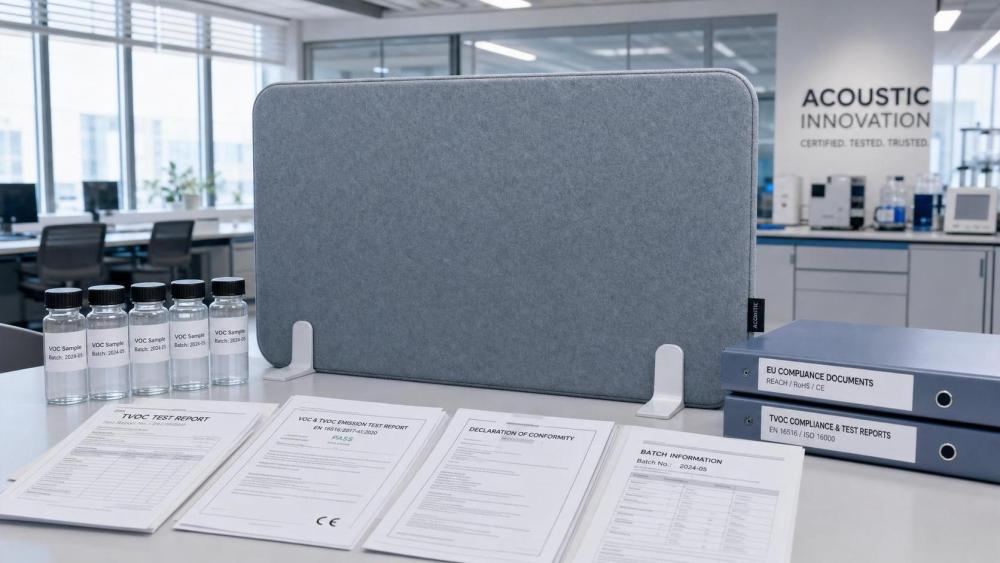
What the rule now requires in the EU market
According to the information provided, CEN stated that the 12-month transition period under EN 17250-2:2026 for office-use PET-based acoustic divider materials ended on June 30, 2026, and the standard has entered mandatory enforcement. The rule applies to PET Acoustic Desk Dividers sold in the EU market.
The requirement specified in the summary is that these products must be supported by a test report issued by an accredited lab showing TVOC less than or equal to 5 μg/m3, with testing conducted under ISO 16000-9:2025. In addition, products must carry a batch-level VOC declaration. The same input also states that TUV Rheinland in Germany has updated its importer audit checklist accordingly.
Where the immediate pressure is likely to appear
Market-entry checks are becoming more document-driven
From an industry perspective, direct trade companies and importers are likely to feel the first operational impact because the rule described here is tied to whether products entering the EU market can be supported by the required test report and batch-level VOC declaration. The practical pressure point is documentation review, especially where importer-side audits or onboarding checks are already part of the transaction flow.
Manufacturing and converting teams face tighter batch accountability
For processing and manufacturing businesses, the stated batch-level declaration requirement suggests that compliance will need to be managed at the batch level rather than only at the product-family level. Analysis shows that this can affect how production lots, internal records, and release documentation are organized, even where the product category itself remains unchanged.
Procurement and channel partners may need clearer supplier evidence
Procurement teams, distributors, and channel operators may also be affected because supplier qualification will likely depend more heavily on whether a compliant accredited-lab report and corresponding batch declaration can be presented in a timely way. What deserves closer attention is not only whether a product has been tested, but whether the evidence aligns with the exact batch being sold or imported.
Service providers around compliance may see faster review cycles
Compliance support firms, testing coordinators, and document-handling service providers may see demand shift toward faster verification and checklist alignment. This observation is based on the fact that the rule is already mandatory and that an importer audit checklist has reportedly been updated in Germany, which can shorten the tolerance for missing or inconsistent paperwork.
What companies should watch now
Test reports must match the stated standard pathway
Companies selling PET acoustic desk dividers into the EU should review whether their existing VOC evidence matches the requirement described in the input: an accredited lab report demonstrating TVOC less than or equal to 5 μg/m3 under ISO 16000-9:2025. This is a practical distinction, because older or differently structured evidence may not address the exact requirement now being enforced.
Batch-level declarations are no longer a side issue
Observably, the batch-level VOC declaration requirement deserves separate attention from the lab test itself. Businesses should focus on how batch identification, supporting records, and outbound documentation are connected, since the requirement is described at the batch level rather than as a broad marketing statement.
Importer-facing paperwork needs closer alignment
The mention of TUV Rheinland updating its importer audit checklist indicates that importer review processes may move quickly from general compliance review to itemized document scrutiny. For companies working through EU importers or local representatives, this makes document consistency, timing, and version control an immediate business issue rather than a background compliance task.
Customer communication should stay factual
For sales and account teams, the safest near-term approach is to communicate in terms of confirmed test scope, confirmed limits, and available batch declarations. Analysis shows that overbroad assurances may create avoidable friction if customer procurement or importer audits ask for evidence in the exact format now expected.
How this development is best understood
This section is analysis rather than fact. It is more appropriate to understand this update as a concrete enforcement shift, not merely a policy signal under discussion. The transition period has ended, and the summary provided frames the requirement as mandatory for PET acoustic desk dividers sold in the EU. At the same time, it should not be overstated into broader conclusions beyond the product scope given in the input.
Observably, the more meaningful industry signal lies in how emissions compliance is being tied to accredited testing and batch-specific declarations within a defined product category. That does not by itself confirm how other adjacent products will be treated, but it does indicate that documentation quality and audit readiness are becoming central to commercial continuity in this segment.
Why the update matters beyond the headline
In practical terms, this development matters because it changes VOC compliance for PET acoustic desk dividers from a transition-stage requirement into an active condition of EU market participation. The immediate consequence is less about abstract standard-setting and more about whether manufacturers, importers, and channel partners can present the required evidence without delay.
Current observation suggests this should be read as an implemented regulatory checkpoint within a specific product segment, with further industry attention focused on execution: accredited testing, batch-linked declarations, and importer-facing review standards. That is a narrower but more actionable reading than treating the news as a general market trend.
Basis of this article and points for continued verification
This article is based on the user-provided news title, event date, and event summary. The content typically relates to source types such as official announcements, standardization body documents, importer compliance materials, industry association updates, and reporting by authoritative trade media. No specific official source link was provided in the input, so the exact source document and any subsequent clarifications still need ongoing verification.
For continued monitoring, the most relevant follow-up areas are any further official wording around EN 17250-2:2026 implementation, how importer audit practices are applied in actual transactions, and whether additional explanatory materials are issued regarding the required accredited lab reports and batch-level VOC declarations.
Related News
- China Tightens Export Inspection for Office Acoustics: PET Dividers and Booths Need NRC ReportsAug 14, 2026China tightens export inspection for office acoustics. PET dividers and booths now need NRC reports, so exporters can avoid delays and clear customs faster.
- EU PPWR Takes Effect Aug. 12, EPR Filing Now RequiredAug 11, 2026EU PPWR takes effect Aug. 12, making packaging EPR filing essential for EU-bound office furniture. Learn how to protect listings, customs clearance, and delivery compliance.
- REACH SVHC Update Triggers PET Divider RetestingAug 10, 2026REACH SVHC update triggers PET divider retesting as three phthalates hit the Candidate List. Learn the 90-day compliance risks, testing actions, and EU market impact.
- CPSC Rule Sets Dual PET Divider ThresholdsAug 08, 2026CPSC Rule Sets Dual PET Divider Thresholds: learn how new U.S. rules for PET acoustic desk dividers impact NRC ratings, formaldehyde limits, compliance documents, and market access.
Related News
- 00
0000-00
How to Evaluate a Commercial Lounge Furniture Manufacturer for High-Traffic Projects - 00
0000-00
Office Furniture Compliance Requirements: A Facility Manager’s Checklist - 00
0000-00
How Smart Office Furniture with Booking Improves Shared Workspace Utilization - 00
0000-00
Chair Comfort Testing: Metrics That Predict All-Day Support in Office Seating - 00
0000-00
Workplace Sedentary Health Solutions: Designing Movement Into Daily Work
Weekly Insights
Stay ahead with our curated technology reports delivered every Monday.