
CPSC Tightens VOC Rules for PET Desk Dividers




On August 2, 2026, the U.S. Consumer Product Safety Commission (CPSC) issued emergency notice CPSC-2026-0087, bringing office-use PET acoustic desk dividers into the mandatory scope of its indoor air quality guidance. The immediate point of attention for exporters, manufacturers, buyers, and supply chain service providers is that imports into the U.S. will face added third-party testing for formaldehyde and total VOCs from October 1, 2026. For companies shipping PET acoustic desk dividers, this is not just a documentation update; it directly affects compliance planning and delivery timing.
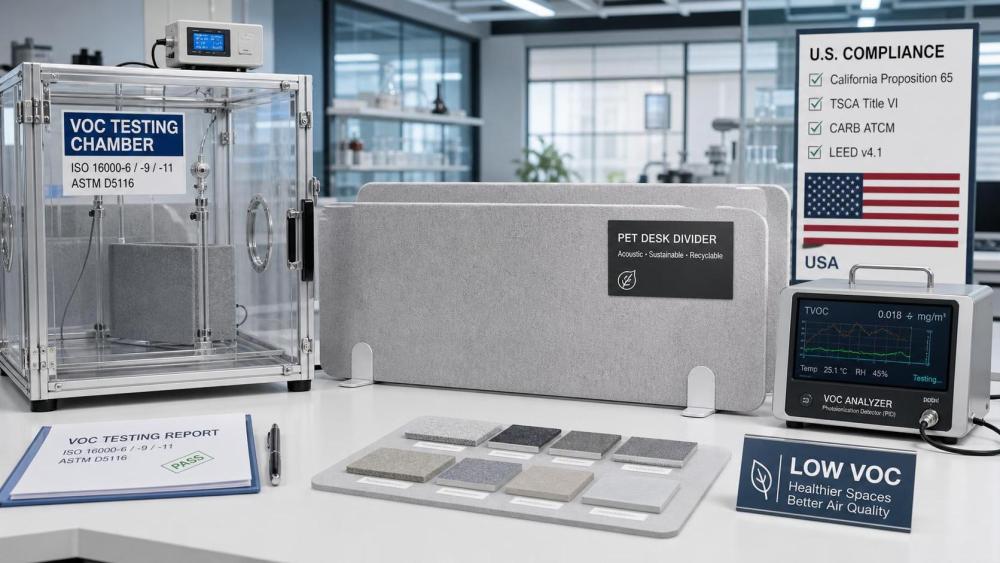
What the Emergency Notice Confirms
The confirmed facts are limited but clear. According to the information provided, the CPSC released emergency notice CPSC-2026-0087 on August 2, 2026. The notice places office PET acoustic desk dividers under mandatory control within the Indoor Air Quality Management Guidelines. From October 1, 2026, all PET Acoustic Desk Dividers imported into the United States must undergo third-party laboratory testing for formaldehyde emissions at no more than 0.05 ppm and total VOCs at no more than 0.5 mg/m3. The required reports must comply with both ASTM D6007-23 and ISO 16000-29:2025. The revision is described as directly affecting the compliance pathway and delivery cycle of Chinese exporters.
Where the Pressure May Appear First
Export-facing suppliers are likely to feel the timing impact first
From an industry perspective, companies that ship PET acoustic desk dividers to the U.S. are the most immediate affected group because the rule applies at the point of import. The practical impact may appear in pre-shipment compliance preparation, test report readiness, and coordination with customers on whether existing product files are still sufficient for orders shipping after October 1, 2026.
Manufacturing and product teams may need to review test readiness
Analysis shows that factories and product compliance teams may be affected through the need for added third-party testing under two named standards. Even where product specifications have not changed, the business issue is whether current internal documentation and product validation are aligned with the new import requirement. What deserves closer attention is not only the limit values themselves, but also the requirement that reports meet both ASTM D6007-23 and ISO 16000-29:2025.
Buyers and sourcing teams may need to reassess order scheduling
For procurement teams, the likely impact is on lead-time assumptions and supplier communication. The notice introduces a compliance step tied to import eligibility, so sourcing decisions may be influenced by whether suppliers can produce valid third-party reports in time for the October implementation date. This matters especially where purchase commitments are already tied to fixed delivery windows.
Supply chain and service providers may see more documentation-related coordination
Observably, testing laboratories, compliance consultants, and trade service providers may face greater demand for document review and timing coordination. The business issue here is less about product redesign, based on the confirmed information, and more about whether shipments, test reports, and customer files can be aligned without creating avoidable delays.
What Companies Should Watch Now
The exact product scope in active orders
Companies should first confirm whether the products they classify and sell into the U.S. fall within the office-use PET acoustic desk divider category referenced in the notice. In practice, this affects order review, product descriptions, and internal compliance mapping for U.S.-bound shipments.
The testing path under dual-standard reporting
What deserves closer attention is the dual-standard requirement. The input confirms that reports must meet both ASTM D6007-23 and ISO 16000-29:2025, so exporters and suppliers should focus on whether their testing arrangements, sample preparation, and report formats can satisfy both requirements for shipments after October 1, 2026.
The gap between rule publication and shipment execution
Analysis shows that the period between the August 2 notice and the October 1 effective date is a key operational window. Companies involved in contracting, production scheduling, and export documentation should pay close attention to how pending orders will be handled, particularly where compliance documents may need to be added before goods enter the U.S. market.
Customer communication and document readiness
For sales, account, and export teams, the immediate practical issue is communication. Buyers may ask whether shipments will carry compliant third-party reports and whether lead times need adjustment. Supplier qualifications, testing documents, and delivery commitments are therefore likely to become part of routine order confirmation discussions.
Why This Looks More Than a Short-Term Filing Change
This section is analysis rather than confirmed fact. It is more appropriate to understand this development as a targeted compliance signal rather than a routine paperwork revision. The notice does not merely restate an existing expectation; it places a named office furniture product into mandatory control and ties U.S. imports to specific formaldehyde and TVOC thresholds under two standards. At the same time, it is still too early, based only on the provided information, to treat this as a wider rule expansion across all office furniture categories. That is why the industry still needs continued observation rather than broad conclusions.
How the Market Should Read This Update
At this stage, the industry significance is clear in operational terms: PET acoustic desk dividers exported to the U.S. now face a more defined compliance threshold, and the burden will likely show up first in testing, documentation, and delivery management. A neutral reading is that this is an actionable regulatory change for the affected product category, while also serving as a policy signal worth monitoring for adjacent office furniture compliance work. It is more appropriate to understand this as a concrete near-term compliance adjustment with possible longer-term implications that still require verification.
Basis of This Article and Ongoing Verification
This article is based on the user-provided news title, event date, and event summary related to the CPSC emergency notice issued on August 2, 2026. For this type of development, relevant source categories typically include official notices, company compliance disclosures, industry association updates, authoritative media coverage, and standards organization documents. No specific official source link was provided in the input, so the exact official publication path still requires continued verification. The main follow-up points to watch are whether the CPSC provides additional interpretive wording, whether implementation details become clearer in practice, and how affected companies align testing and shipment schedules before October 1, 2026.
Related News
- China Tightens Export Inspection for Office Acoustics: PET Dividers and Booths Need NRC ReportsAug 14, 2026China tightens export inspection for office acoustics. PET dividers and booths now need NRC reports, so exporters can avoid delays and clear customs faster.
- EU PPWR Takes Effect Aug. 12, EPR Filing Now RequiredAug 11, 2026EU PPWR takes effect Aug. 12, making packaging EPR filing essential for EU-bound office furniture. Learn how to protect listings, customs clearance, and delivery compliance.
- REACH SVHC Update Triggers PET Divider RetestingAug 10, 2026REACH SVHC update triggers PET divider retesting as three phthalates hit the Candidate List. Learn the 90-day compliance risks, testing actions, and EU market impact.
- CPSC Rule Sets Dual PET Divider ThresholdsAug 08, 2026CPSC Rule Sets Dual PET Divider Thresholds: learn how new U.S. rules for PET acoustic desk dividers impact NRC ratings, formaldehyde limits, compliance documents, and market access.
Related News
- 00
0000-00
How Integrated Charging Lounge Furniture Supports Productive Hybrid Workspaces - 00
0000-00
How to Specify Conference Room Furniture With Power for Hybrid Meeting Spaces - 00
0000-00
How to Assess Office Furniture Surface-Finishing Suppliers for Durability and Compliance - 00
0000-00
How Open-Plan Workplace Design Can Improve Productivity Without Raising Noise - 00
0000-00
Commercial Office Desk Procurement: A Checklist for Hybrid Workplace Projects
Weekly Insights
Stay ahead with our curated technology reports delivered every Monday.