
BIFMA Draft Raises Bar for PET Desk Dividers




On June 24, 2026, BIFMA released the draft standard X5.9 Draft Standard for Acoustic Desk Partitions, putting new proposed entry thresholds on PET Acoustic Desk Dividers for acoustic performance, flammability, and VOC emissions. For exporters, distributors, manufacturers, and sourcing teams tied to the North American office furniture channel, this matters because the draft is already affecting order review activity and sets a near-term compliance timetable ahead of its planned Q2 2027 implementation.
What the draft standard now puts on the table
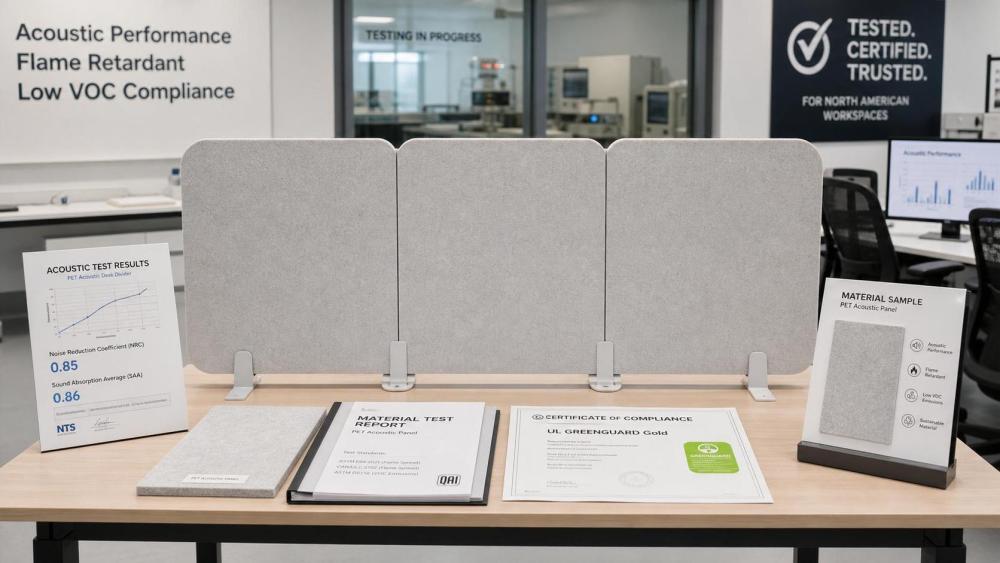
According to the information provided, BIFMA issued the consultation draft on June 24, 2026. The draft would, for the first time, make the following thresholds mandatory for PET Acoustic Desk Dividers: NRC of at least 0.75, a flammability rating of UL 94 HB or higher, and VOC emissions of no more than 5 μg/m³ after 72 hours. The draft is planned for formal implementation in Q2 2027.
The same information indicates that the draft has already led some large North American distributors to pause approval of new orders. It also states that Chinese exporters need to complete material-level testing and update declarations within Q3 2026, or they may face channel access risk.
Where the pressure is likely to appear first
Order approval is becoming an immediate issue for exporters
From an industry perspective, direct trade companies are likely to feel the first impact in quotation, sampling, and order confirmation. The reason is straightforward: if large distributors are already pausing new order approvals, exporters may face delays even before the standard is formally implemented. What deserves closer attention is whether current product files, declarations, and testing documents can support customer review without gaps.
Material and process teams may need earlier validation
For processing manufacturers and upstream material procurement teams, the draft points attention to material-level verification rather than only finished-product claims. The practical effect is likely to appear in testing preparation, technical document updates, and internal coordination between sourcing and production. Teams handling PET-based acoustic partitions should watch whether existing materials can meet the proposed NRC, UL 94 HB, and VOC thresholds under the required test conditions.
Channel operators are likely to tighten screening before rollout
For distributors and channel-side review teams, the reported pause in new order approvals suggests that compliance screening may move forward ahead of the formal enforcement date. Observably, this affects onboarding, product listing review, and supplier communication. The key change to watch is not only the final implementation date, but also how early channel partners begin treating the draft as a practical precondition for business.
Buyers and downstream users may shift risk upstream
Procurement parties and downstream commercial buyers may not be the ones running tests, but they are directly exposed to delivery and approval risk. Analysis shows that their concern is likely to center on continuity of supply, document completeness, and whether suppliers can confirm updated declarations within the stated timeline. In this context, compliance readiness may become part of supplier evaluation even before the standard formally takes effect.
What companies should track now
Separate draft language from immediate channel behavior
Companies should distinguish between two layers of impact: the draft itself and the business response already emerging around it. The confirmed fact is that the standard is still a draft with planned implementation in Q2 2027. At the same time, the reported pause in new order approvals shows that market behavior may move faster than the formal schedule.
Review whether material-level testing is already in place
The near-term operational issue is the Q3 2026 window cited for Chinese exporters to complete material-level testing and declaration updates. For companies shipping PET Acoustic Desk Dividers, this is less about general compliance messaging and more about whether test evidence and supporting statements are aligned with the proposed thresholds.
Check declarations, technical files, and customer-facing documents
What deserves closer attention is document consistency across the sales and supply chain process. If quotations, specifications, declarations, and supporting test materials are updated at different times, that can create friction in order review and customer communication. The practical focus should be on whether the same compliance position is reflected across all transaction documents.
Prepare for customer communication before final enforcement
Because the draft has already influenced distributor approval activity, suppliers may need a clearer communication plan for ongoing and pending business. Analysis shows that the issue is not limited to final certification outcomes; it also includes how suppliers explain testing status, declaration updates, and expected timelines to buyers who may be reassessing purchase decisions.
Why this looks like more than a routine draft
Analysis shows that this development is better understood as an early market signal with immediate commercial effects, rather than as a distant regulatory milestone. The standard has not yet reached formal implementation, so it would be premature to treat all outcomes as settled. However, the combination of defined technical thresholds, a stated implementation timetable, and distributor order pauses suggests that market access expectations may already be changing.
Observably, the most important point is not only that a draft exists, but that compliance topics once handled later in the sales cycle may now move upstream into product development, material selection, and channel review. That is why the event deserves continued attention even before the final standard is in force.
How this news is best understood at this stage
At this stage, it is more appropriate to understand the BIFMA X5.9 draft as a concrete warning signal for companies selling PET Acoustic Desk Dividers into North America. The confirmed facts do not yet establish final market outcomes across the whole sector, but they do show a clear direction: technical thresholds are becoming more explicit, and channel acceptance may tighten ahead of formal implementation. For companies affected by this product category, the near-term issue is readiness, not just observation.
Basis of this article and points for follow-up
This article is based on the user-provided news title, event date, and event summary. Information of this type is commonly associated with official announcements, standard organization documents, industry association releases, company notices, and reporting by authoritative trade media. A specific official source link was not provided in the input, so the exact source document link still needs continued verification.
For follow-up, the main areas to watch are whether BIFMA revises the draft language during consultation, whether the planned Q2 2027 implementation schedule changes, and how North American distributors continue to handle new order approvals before formal adoption.
Related News
- China Tightens Export Inspection for Office Acoustics: PET Dividers and Booths Need NRC ReportsAug 14, 2026China tightens export inspection for office acoustics. PET dividers and booths now need NRC reports, so exporters can avoid delays and clear customs faster.
- EU PPWR Takes Effect Aug. 12, EPR Filing Now RequiredAug 11, 2026EU PPWR takes effect Aug. 12, making packaging EPR filing essential for EU-bound office furniture. Learn how to protect listings, customs clearance, and delivery compliance.
- REACH SVHC Update Triggers PET Divider RetestingAug 10, 2026REACH SVHC update triggers PET divider retesting as three phthalates hit the Candidate List. Learn the 90-day compliance risks, testing actions, and EU market impact.
- CPSC Rule Sets Dual PET Divider ThresholdsAug 08, 2026CPSC Rule Sets Dual PET Divider Thresholds: learn how new U.S. rules for PET acoustic desk dividers impact NRC ratings, formaldehyde limits, compliance documents, and market access.
Related News
- 00
0000-00
How to Evaluate a Commercial Lounge Furniture Manufacturer for High-Traffic Projects - 00
0000-00
Office Furniture Compliance Requirements: A Facility Manager’s Checklist - 00
0000-00
How Smart Office Furniture with Booking Improves Shared Workspace Utilization - 00
0000-00
Chair Comfort Testing: Metrics That Predict All-Day Support in Office Seating - 00
0000-00
Workplace Sedentary Health Solutions: Designing Movement Into Daily Work
Weekly Insights
Stay ahead with our curated technology reports delivered every Monday.