
ASTM F2100-26 expands biocompatibility checks




On June 1, 2026, the updated U.S. ASTM F2100-26 standard for medical masks took effect and introduced mandatory biocompatibility requirements for air-contact materials under ISO 10993-5 and ISO 10993-10. Although the standard is written for masks, the event summary indicates that FDA field inspections have already extended this review logic to enclosed office equipment, including human-close-contact parts used in Acoustic Phone Booths ventilation systems. For suppliers, importers, procurement teams, and testing-related service providers, the immediate issue is no longer only product design, but also whether supporting documents for filters, sealants, and lining fabrics can satisfy added review expectations in trade and delivery.
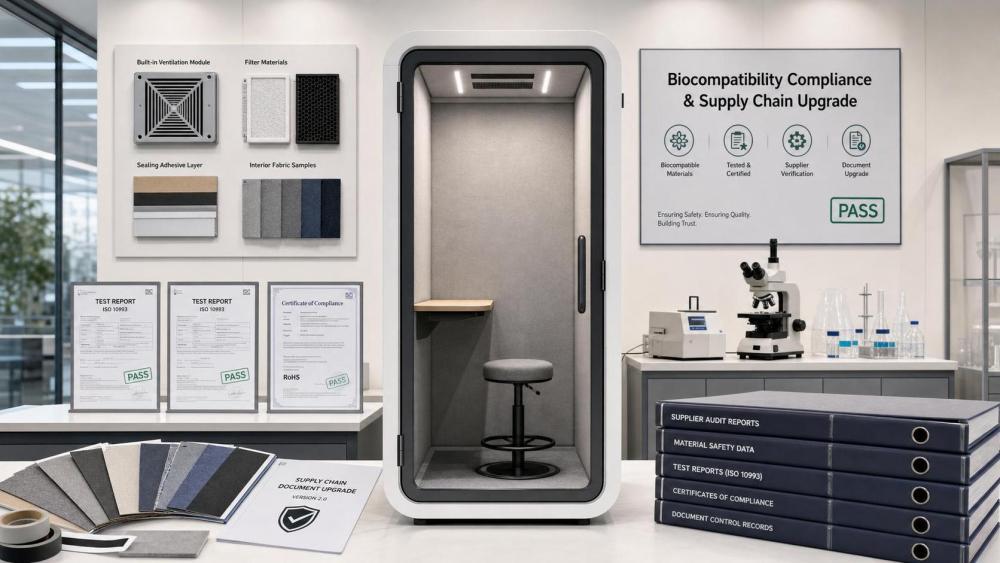
What the change clearly confirms
According to the provided information, ASTM F2100-26 formally came into effect in the United States on June 1, 2026. The updated version makes biocompatibility of air-contact materials a mandatory requirement for medical masks, specifically referencing ISO 10993-5 and ISO 10993-10.
The same information states that, in multiple on-site FDA inspections, this requirement has been extended beyond masks to enclosed office equipment. The cited scope includes Acoustic Phone Booths and the close-contact components within embedded ventilation systems, such as filters, sealants, and lining textiles.
The event summary also confirms a current market response: importers in the United States and Canada are asking suppliers to provide additional cytotoxicity and skin sensitization test reports.
Where pressure is likely to appear across the supply chain
Suppliers of ventilation-related materials may face document upgrades
From an industry perspective, suppliers of filters, sealants, and interior textile materials may be affected first because the new requests focus on materials that are used close to people in enclosed airflow environments. The main impact is likely to appear in technical file preparation, material qualification, and the ability to provide cytotoxicity and skin sensitization reports when customers request them.
Booth manufacturers may see compliance move upstream
For manufacturers of Acoustic Phone Booths, the practical issue is not limited to the final assembled product. Analysis shows that compliance review may move upstream into bill-of-material decisions, supplier selection, and component substitution control, especially where embedded ventilation modules contain materials now being questioned during import or customer review.
Importers and buyers may tighten pre-shipment review
Importers and procurement teams in the U.S. and Canada are already described as requesting added test reports. That means purchasing decisions, tender documentation, and pre-shipment checks may increasingly depend on whether suppliers can present biocompatibility-related records alongside existing technical documentation. What deserves closer attention is that a missing report may become a delivery or acceptance issue even before any formal dispute appears.
Testing and certification support functions may become more involved
Testing service providers and certification-related teams may also see a more active role, because the immediate market signal is a request for evidence rather than a general policy discussion. The business effect is likely to center on report readiness, document consistency, and interpretation of which ventilation-module materials fall within customer review scope.
What companies should review now
Check which materials are likely to be treated as human-close-contact parts
Analysis shows that companies involved with Acoustic Phone Booths should first identify whether filters, sealants, lining fabrics, or similar materials in ventilation modules could be treated by customers or inspectors as air-contact or close-contact components. This is a scoping exercise, but it directly affects what documents may be requested later.
Align technical files with test-report expectations
Where buyers are already asking for cytotoxicity and skin sensitization reports, suppliers should review whether their current material files, declarations, and test records are sufficient for transaction review. If not, the gap is likely to surface during quotation, supplier onboarding, or pre-delivery document checks rather than only at the point of import.
Watch for changes in procurement language and bid documents
Observably, the most immediate execution signal may appear in procurement specifications and customer document requests. Companies should pay attention to whether purchase orders, supplier qualification lists, technical agreements, or tender materials begin to reference ISO 10993-5, ISO 10993-10, or broader biocompatibility expectations for ventilation-related parts.
Prepare for timing and delivery risk, not only pass-fail compliance
From an industry perspective, this development should also be watched as a delivery-management issue. If reports are requested late in the order cycle, material approval, shipment scheduling, and replacement-part planning may all be affected. The current information does not confirm a uniform enforcement mechanism, so the key is to monitor where document requests begin to delay transactions or acceptance.
How this signal should be read at this stage
Analysis shows that this is more than a narrow mask-standard update, because the provided event summary links the new requirement to FDA inspection practice involving enclosed office equipment. At the same time, it is more appropriate to understand this as an active enforcement signal rather than a fully settled, all-scenarios rulebook for every booth product and every component.
What deserves closer attention is the combination of two factors: a standard that now makes biocompatibility mandatory for air-contact materials, and downstream market participants already demanding supporting test evidence from suppliers. That combination suggests the issue is moving from abstract compliance awareness into practical document review and supplier screening.
Why the market is likely to keep watching
For the industry, the significance of this event lies in the widening compliance lens around materials used near occupants in enclosed airflow settings. The confirmed facts do not establish every future enforcement detail, but they do indicate that biocompatibility review is becoming relevant to product categories outside the original mask context when inspection and buyer practice extend the requirement.
It is more appropriate to understand this development as a landed change with ongoing interpretation risk: the standard is already in force, customer document requests are already appearing, and the remaining uncertainty is how consistently review scope, supporting evidence, and procurement language will develop across projects and transactions.
Basis of this article and what still needs verification
This article is generated from the user-provided news title, event date, and event summary. For developments of this kind, commonly relevant source types may include official notices, regulator communications, trade or customs authority information, industry association updates, standards organization documents, and reporting by authoritative media.
No specific official source link was provided in the input, so the exact official link remains to be verified on an ongoing basis. Observably, the areas that still require continued checking include detailed enforcement wording, certification and testing interpretation, changes in tender or procurement documents, market feedback from importers and buyers, and how companies implement the requirement in actual delivery and supplier-management processes.
Related News
- EU Battery Rules Now Require Carbon Footprint Declarations for Exported Office BoothsAug 16, 2026EU battery rules now require carbon footprint declarations for exported office booths. Learn how this impacts CE updates, EPR registration, customs clearance, and delivery planning.
- How to Plan Acoustic Booth Design for Offices Without Wasting Floor SpaceAug 16, 2026acoustic booth design for offices can save floor space while improving privacy. Learn how to plan the right booth size, placement, and ventilation to avoid costly layout mistakes.
- U.S. CPSC Rule Takes Effect for Acoustic Phone Booths Under ASTM F2975-24Aug 15, 2026U.S. CPSC Rule Takes Effect for Acoustic Phone Booths under ASTM F2975-24. Learn the new 3.5 ACH, 225 kg, and 2-second compliance rules before exports, testing, and customs are affected.
- CPSC Rule Takes Effect for Acoustic Phone BoothsAug 06, 2026Acoustic Phone Booths face a major U.S. compliance shift as the CPSC rule takes effect. Learn how 16 CFR Part 1279 impacts testing, certification, sourcing, and market access.
Related News
- 00
0000-00
How to Evaluate a Commercial Lounge Furniture Manufacturer for High-Traffic Projects - 00
0000-00
Office Furniture Compliance Requirements: A Facility Manager’s Checklist - 00
0000-00
How Smart Office Furniture with Booking Improves Shared Workspace Utilization - 00
0000-00
Chair Comfort Testing: Metrics That Predict All-Day Support in Office Seating - 00
0000-00
Workplace Sedentary Health Solutions: Designing Movement Into Daily Work
Weekly Insights
Stay ahead with our curated technology reports delivered every Monday.